wand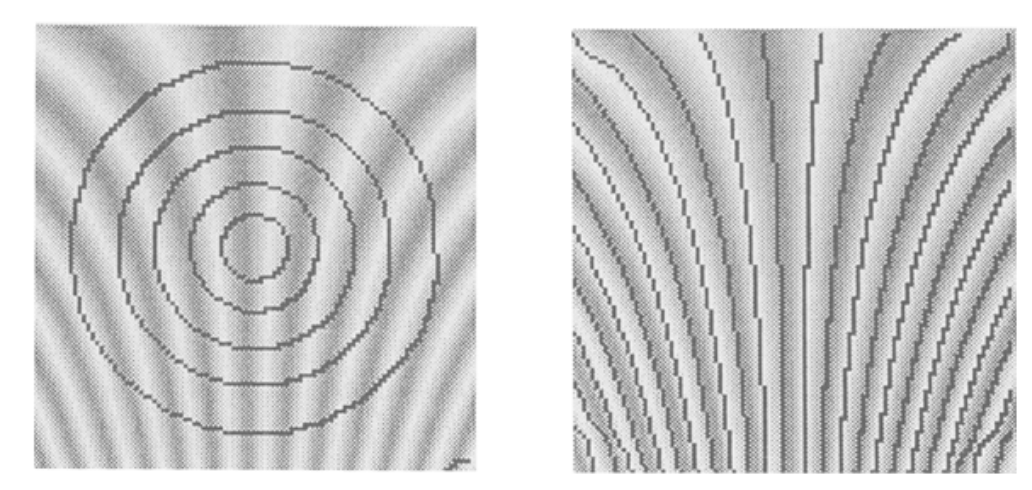 Left: contours of equal amplitude. Right: contours of equal phase.
Link to paper
Left: contours of equal amplitude. Right: contours of equal phase.
Link to paper
In a very similar vein to A&B, this paper explicitly constructs convolutional filters used to measure optical flow (or pixel velocities). They focus on spatiotemporal bandpass filters that can extract the amplitude and phase of a group of wavelengths within a video in the neighborhood of a single point. The phase indicates the position of the point within an oscillation of that frequency, a property that seems to be preserved up to scaling, shearing, rotation, brightness changes, etc. Thus, assuming phase is constant for a given point, we can use to estimate optical flow (just track where you need to go to keep phase constant).
There’s some stuff about components I don’t really get. I think the math overall here was not super accessible to me but the general idea seems really interesting (frequency invariances as opposed to just brightness ones). I wonder if frequencies (especially directionless measures of frequency) may give us better invariances to work with than just brightness, especially when brightness is involved.
Uncertainty principle
One discussion that was quite interesting was the uncertainty principle in filtering, i.e. in order to have extremely high spatial resolution it’s hard to have high time resolution and vice-versa. In fact the math seems to be related to that underlying the uncertainty principle from quantum, i.e. a general property of Fourier transforms.
Tags
Frequency analysis Phase constancy Hand-designed filters Local methods Neuroscience NOT deep learning Old school Optical flow Robustness to noise Unsupervised
Cited
Cited By
Return: index